
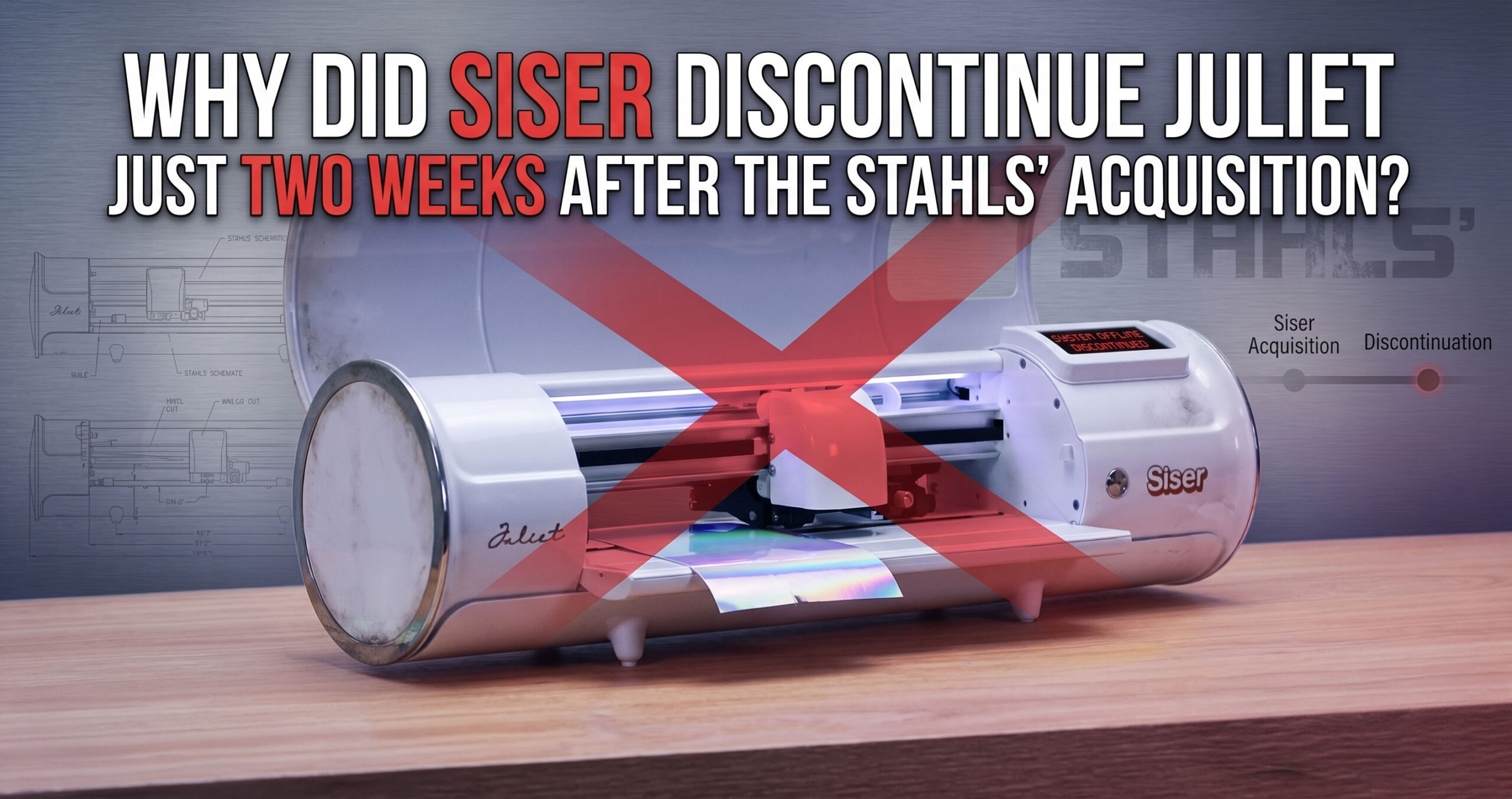
Let me begin with the part we know for certain.
On July 15, 2026, STAHLS’ announced that it had acquired Siser, bringing the heat-transfer-vinyl manufacturer into the STAHLS’ family of companies. Siser was expected to continue operating under its own name, while the two companies collaborated on product development, customer support and global growth. The financial terms were not disclosed.
Then, on July 29, exactly two weeks later, Siser North America posted a letter announcing that it would discontinue the Juliet High-Definition Cutter. The company said Leonardo Design Studio would remain available and continue supporting both Juliet and Romeo. Siser’s choice of wording was interesting: it referred to “the current Juliet” being discontinued, which leaves open the possibility that something else could eventually replace it, but no replacement had been announced as of August 4, 2026.
Two weeks.
That does not prove the acquisition caused the decision. In fact, acquisitions usually involve months of negotiations, financial reviews and product-level due diligence, so it is entirely possible that the fate of Juliet had already been discussed long before the deal became public.
But I also do not think we should pretend the timing means nothing.
Juliet was Siser’s direct attempt to compete in the desktop cutting-machine market. It could cut HTV, adhesive vinyl, cardstock, stickers, craft foam and other materials, and its 12-inch format placed it directly in the territory occupied by Cricut, Silhouette and Brother.
Discontinuing that machine almost immediately after an acquisition deserves a closer look, especially when the acquiring company is investing so heavily in a technology that can eliminate the need for a cutter in one of Juliet’s largest potential markets.
That technology is DTF.
The Timing Is Impossible to Ignore
I want to be careful here because there is no public statement from either Siser or STAHLS’ saying, “We discontinued Juliet because of DTF.”
That would be an assumption.
What we can say is that STAHLS’ acquired Siser on July 15, and Siser announced Juliet’s discontinuation on July 29. We can also say that STAHLS’ already had a close relationship with Siser before the acquisition. STAHLS’ became an official North American distributor of Siser products in November 2025 and began prominently promoting Siser’s Romeo cutter, EasyWeed and other materials.
In other words, STAHLS’ was not introduced to Juliet’s business on July 15. It likely had a good understanding of Siser’s cutter line, its customers and how the equipment fit into the broader apparel-decorating market well before the acquisition closed.
That makes it unlikely that someone at STAHLS’ looked at Juliet for the first time and decided to kill it within fourteen days. A much more realistic possibility is that Juliet’s future had already been evaluated during the acquisition process, and the announcement came shortly after the deal because the decision was ready to go.
There is also a strange disconnect between the announcement and Siser’s website. As of August 4, Siser’s North American homepage was still describing Romeo and Juliet as its line of professional cutters, and the Juliet product page was still live and presenting the machine as a current product. That may simply be a delayed website update, but it adds to the feeling that the announcement happened abruptly.
It is also worth noticing what was not discontinued.
Romeo, the 24-inch version, was not named in the Juliet announcement. STAHLS’ had already been promoting Romeo as a professional production cutter for apparel decorators, emphasizing its larger cutting area and business-oriented capabilities.
That could indicate a fairly straightforward product-positioning decision. Juliet was the smaller cutter that pushed Siser into the crowded consumer and prosumer craft market. Romeo fits more naturally into STAHLS’ existing commercial-decorator audience.
If you are STAHLS’, do you really want to spend the money required to compete directly with Cricut in the mass-market craft-machine business? Or do you keep the larger production cutter that fits your established customer base and redirect your attention toward the technology that is changing apparel decoration?
I think that is the more interesting question.
DTF Changed the Math for Apparel
For years, the appeal of a desktop cutting machine was easy to understand.
Buy a Cricut, Silhouette or similar machine. Buy some HTV. Cut a name, phrase or graphic. Weed it. Press it. Sell the shirt.
It was affordable, approachable and did not require commercial printing equipment. It created an enormous market for cutters, blades, mats, tools and rolls of vinyl.
The limitation was color.
A one-color design was easy. A two-color design was manageable. Once you reached four, five or six colors, every layer required more material, more cutting, more weeding, more alignment and usually more heat-press cycles. Tiny details could lift during weeding. Thin text could stretch. Layer alignment could shift. Certain types of HTV could not be layered at all.
DTF changes that calculation because the number of colors barely changes the production workflow.
A one-color design and a twenty-color design are both digitally printed onto film. Gradients, distressed textures, tiny highlights, shadows and complex illustrations arrive as one finished transfer. The decorator positions the transfer, presses it and peels the carrier according to the supplier’s instructions.
That does not mean DTF is perfect.
DTF can have a heavier feel than screen printing or direct-to-garment printing because the transfer sits on top of the fabric. Large solid areas may feel more like a patch of ink than a soft screen print. Print quality depends on the printer, ink, film, powder, RIP software, curing process and application. Poorly produced transfers can crack, feel rubbery or have inconsistent color.
But for the typical small apparel order, the advantages are hard to ignore.
A customer can order twelve black shirts with a full-color logo, ten white shirts with the same artwork and three hoodies with customized names. That type of job is awkward for traditional screen printing and tedious with layered vinyl. It is exactly the kind of work DTF handles well.
Trade coverage describes DTF as filling the gap where full-color screen printing is not economical for short runs and where HTV becomes limited by color and labor.
That is why I think DTF does more than compete with HTV as a material.
It competes with the need to own a cutter at all.
If your primary reason for buying a cutting machine was to make shirts, and you can now order a full-color transfer for a few dollars, why spend hours cutting and weeding vinyl?
That question is going to matter to every cutting-machine manufacturer.
Paper Crafters Are Stuck in the Middle
This is the part I think the broader apparel industry overlooks.
Paper crafting helped build the consumer cutting-machine market.
Long before every other person was making vinyl decals and T-shirts, electronic cutters were associated with scrapbooking, cards, titles, embellishments, shaped layouts and paper piecing. A machine’s ability to cut detailed cardstock shapes was a huge part of its appeal.
But the scrapbooking market was already showing signs of contraction by 2013. One industry observer noted that Walmart, Target and Michaels had reduced the amount of floor space devoted to scrapbooking, specialty stores were disappearing, and Google search interest for scrapbooking had fallen substantially from its mid-2000s peak. That was not a formal industry census, but it reflected a shift that many longtime paper crafters witnessed firsthand.
From roughly 2013 through 2015, the center of the cutting-machine world seemed to move.
Paper did not disappear, but vinyl, HTV, decals, signs, tumblers and apparel increasingly drove the conversation. Cutting-machine marketing became less about scrapbook pages and more about starting a T-shirt business, personalizing everything in the house and selling products online.
You can see that blended positioning today. Cricut describes its Explore 5 in terms of vinyl decals, full-color stickers, personalized T-shirts and cards. Paper crafting is still included, but it is one application among many rather than the clear center of the ecosystem.
Siser took the same approach with Juliet. It was primarily connected to Siser’s HTV and adhesive-vinyl business, but it was also a very capable cardstock and sticker cutter.
That created an unusual situation.
The apparel market helped justify the development and sale of better cutters, and paper crafters benefited from those machines even if they never cut a single piece of HTV.
Now DTF is removing the cutter from a growing portion of the apparel workflow.
DTF does not replace a cutting machine for paper. You cannot order a DTF transfer and turn it into a dimensional card, gift box, lantern, scrapbook layout or layered cardstock centerpiece.
But if apparel decorators buy fewer cutters, the total market for cutters becomes smaller. A smaller market can mean fewer new machines, less competition, slower software development and fewer companies willing to support a consumer craft platform.
That is why paper crafters are stuck in the middle.
The technology threatening cutter demand does not replace what paper crafters do. It simply reduces the number of other customers helping support the hardware ecosystem.
Cricut is not literally the only remaining choice. Silhouette continues selling Cameo machines designed for vinyl, cardstock, heat-transfer material, scrapbooking and apparel. Brother still has an extensive ScanNCut line with built-in scanning and models aimed at crafting, sewing and business users.
But Cricut remains one of the few truly mass-market, beginner-oriented ecosystems with a broad machine lineup covering compact, standard, premium and wide-format use. Cricut currently markets machines for everyone from beginners to experienced crafters and supports projects ranging from intricate paper crafts to shirts, stickers, decals and cards.
That makes the loss of Juliet more concerning than the discontinuation of one machine.
Juliet represented another serious competitor in the 12-inch desktop category. Competition is good for customers. It pressures companies to improve cutting accuracy, software, print-and-cut performance, material handling and customer support.
When a strong competitor exits, Cricut does not become the only choice, but the mainstream field gets thinner.
My Prediction for the Cutting-Machine Market
My prediction is that DTF will put pressure on the entire desktop cutting-machine market.
Not because DTF replaces everything cutters do. It clearly does not.
It will put pressure on the market because apparel was one of the easiest ways to sell cutting machines to people who did not consider themselves traditional crafters.
Someone might not care about scrapbooking or card making, but they understood the idea of buying a machine, making shirts and starting a side business. That promise sold machines, vinyl, tools, heat presses, subscriptions and digital designs.
DTF changes the promise.
Now the easiest version of a shirt business may be:
Create or purchase the artwork.
Order the transfers.
Press the shirts.
Sell them.
The cutter is optional.
As that becomes more widely understood, some people who would have bought a Cricut, Juliet or Cameo primarily for apparel may skip the cutter entirely. Others who already own machines may stop replacing them because they are no longer cutting enough HTV to justify an upgrade.
We may already be seeing signs of a mature hardware market, although it is far too early to blame DTF for any one company’s results. In Cricut’s first quarter of 2026, product revenue declined 9.6% year over year even as platform revenue grew nearly 6%. Cricut also reported modest active-user growth and increased global machine sell-through, so the numbers show a mixed market rather than a collapse.
Still, the business incentive is clear. Recurring software, content, materials and fulfillment revenue can be more attractive than fighting over one-time hardware sales in a crowded category.
From STAHLS’ perspective, DTF transfers are especially appealing because the company can sell the customer something every time an order arrives. A cutter may be purchased once and used for years. A roll of vinyl lasts through multiple projects. Custom transfers, however, must be reordered continuously.
That does not mean STAHLS’ acquired Siser in order to eliminate Juliet. There is no evidence of that.
The acquisition also gives STAHLS’ a respected HTV brand, a large material catalog, manufacturing expertise, dealer relationships and access to Siser’s customer community. Vinyl remains profitable, and STAHLS’ openly promotes using vinyl alongside DTF.
But when I put the pieces together, I see a plausible business explanation for Juliet’s departure.
Juliet occupied the most crowded part of the cutter market. It competed with Cricut, Silhouette and Brother for desktop space. Supporting it required hardware inventory, replacement parts, software development, firmware updates, technical support, education and retailer commitment.
Romeo fits more naturally into a professional apparel-production environment.
DTF is reducing the need for cutters in full-color apparel.
And STAHLS’ is building a business around supplying ready-to-press transfers to decorators who may never need a cutter in the first place.
Again, that is my interpretation, not an explanation officially provided by Siser or STAHLS’.
But I do not think Juliet’s discontinuation is an isolated event. I think it may be an early signal of a larger change.
For years, apparel helped pull the cutting-machine industry forward while paper crafters came along for the ride. Now apparel production is beginning to move toward workflows that do not require cutting machines.
Vinyl is not dead. Screen printing is not dead. Cutters are not dead.
They are becoming more specialized.
Vinyl will remain valuable for specialty finishes, lettering, numbering, fast personalization and mixed-media work. Screen printing will remain highly competitive for larger production runs. Cutting machines will remain indispensable for cardstock, adhesive vinyl, paper engineering and many forms of detailed craft work.
But for ordinary full-color apparel, DTF is quickly becoming the default answer.
And if apparel stops being a major reason people buy desktop cutters, paper crafters may discover that the machine market they helped create is suddenly a much smaller place.
On the other hand, I’m still holding on to Patrick’s post where he indicated that the “current” Juliet is being discontinued, and hoping that a new model is imminent. (Patrick is the “face” of the company and does all of their wonderful social media videos)
Thanks for reading!

Leo Kowal
Moonshadow Craft Company Founder
Leo Kowal is the founder of Moonshadow Craft Co. and a longtime designer, educator, and innovator in the paper-crafting community. He enjoys sharing creative projects, practical techniques, and honest advice to help makers get more from their cutting machines.